
GLP-1 weight loss drugs | Figures, examples and how to adapt your menu
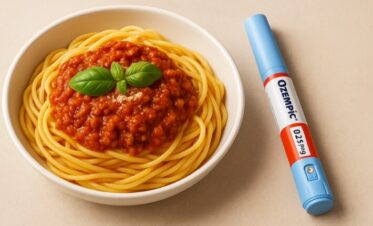
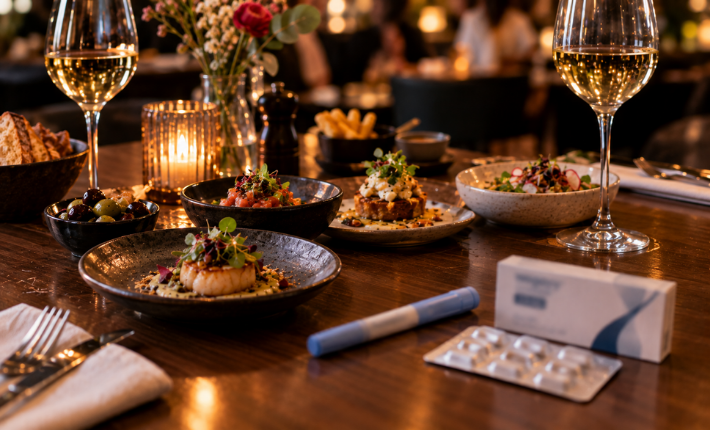 AI generated image
Ozempic, Wegovy, Mounjaro: you’re reading about those GLP-1 weight loss drugs more and more often in the Netherlands, and increasingly in connection with the hospitality industry. In 2025 we already published a blog about the Ozempic menu. Back then it was still mainly a foreign curiosity. Now McDonald’s is adapting its menu in the US, and that is a different league altogether. In this blog, Marjolein van Spronsen puts it all in order: the numbers, the behaviour of users, how the chains are responding and how to adapt your menu as a hospitality industry entrepreneur.
4 minutes read
What is GLP-1? The ‘food noise’ disappears
GLP-1 is a gut hormone that suppresses appetite and prolongs the feeling of fullness. Medications such as Ozempic and Wegovy (semaglutide) and Mounjaro and Zepbound (tirzepatide) mimic this hormone. They were originally developed for type 2 diabetes, but more and more people are using them to lose weight.
For the hospitality industry the effect matters: users feel less hungry and have fewer impulses. In an article, Ali Furman, consumer markets industry leader at PwC, describes this as the disappearance of ‘food noise’: the constant background question of whether you want another snack or drink. A large part of our industry, especially the fast-food chains, lives off exactly that impulse. Want to read more? See the article ‘McDonald’s exec says GLP-1 boom is an opportunity’.
AI generated image
How many people use GLP-1 weight loss drugs?
In our blog about the ‘Ozempic menu’ from last year, we mentioned 8 to 10% of Americans, based on an article in the New York Times. Gallup now reports that 11% of American adults are using GLP-1 weight loss drugs in 2026, compared with 3% in 2024. A further 15% have used them at some point. The pill versions are only just getting started: the Wegovy pill has already passed 5 million prescriptions in the US.
For the Netherlands we could not find hard, representative figures. A survey by RTL Nieuws (sorry, only available in Dutch) among its own panel points to hundreds of thousands of users, three in ten of whom obtain the drugs outside their GP’s knowledge. Health insurers do not broadly reimburse these drugs for weight loss. That may change: since 15 June 2026, France has reimbursed Wegovy and Mounjaro for obesity, the first EU country to do so. It was recently in the Dutch news that Katwijk’s town council has given the go-ahead for the construction of a large pharmaceutical factory belonging to the American pharmaceutical company Eli Lilly (diabetes and weight loss pills) near Valkenburgse Meer.
What do GLP-1 weight loss drugs users do differently in restaurants?
As you might expect: users keep visiting restaurants, but they spend less and choose differently. In the US there is even an app that helps users choose from the menu. Menu-Order-AI offers concrete guidance and lets users decide in real time what is best to order.
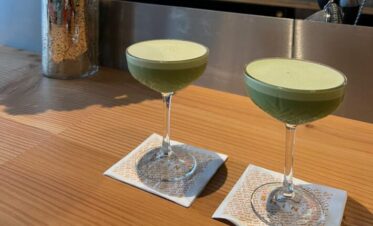
Of course, users also spend less in the hospitality industry. In the US, this lower spending has already been measured. Households with a GLP-1 user spend around 8% less on fast food, coffee shops and other restaurants within six months (Journal of Marketing Research). PwC arrives at almost 9% less at quick-service restaurants. According to PwC, a third of users also want smaller portions at a lower price, and 32% want half portions or sharing dishes without a surcharge. Some users also eat out less often, and demand for protein-rich food is rising. Some drink less alcohol, which explains the rise of mini martinis, the ‘snaquiri’ (a small daiquiri) and an entire GLP-1 smoothie section at Smoothie King about which I wrote in the ‘Ozempic menu’ blog.
How fast-food chains are responding to GLP-1 weight loss drugs
The article mentioned above states that 84% of households with a GLP-1 user still visit McDonald’s as usual. They currently order mainly McNuggets, Filet-O-Fish and Happy Meals. At its investor day in September 2026, the chain announced protein-rich options: grilled chicken sandwiches, wraps and egg bites, as part of an $8.5 billion investment over ten years. Grilled chicken and salads were removed from the menu in 2020 to simplify operations; now they are coming back.
McDonald’s USA president Skye Anderson says the chain does not need to win a new customer group, but should give existing customers a reason to choose McDonald’s first. CEO Kempczinski stresses that this is a long-term plan that differs per market.
Shake Shack launched the ‘Good Fit Menu’ with GLP-1-friendly choices, where almost all burgers can be served in a lettuce wrap. Chipotle has a web page for guests on their ‘GLP-1 journey’. Both name the subject openly.
How are restaurants responding?
Worldwide there are supporters and opponents of fine-dining menus for GLP-1 users. Many top restaurants already serve small portions, but top chef Heston Blumenthal was one of the first to make the news with a special tasting menu in (even) smaller portions (The Thin Duck). There are also sceptics and they have a point: a separate menu can make operations needlessly complicated, and few GLP-1 users are likely to go for an extended dinner at a top restaurant. A dedicated GLP-1 line therefore does not suit every concept.
Moreover, an ‘Ozempic menu’ is really a menu for small eaters. Think of people in their sixties who, on holiday, would rather have two starters, or one course and cheese, than a five-course menu with no choice. According to KleinePorties.nl (small portions.nl, sorry in Dutch), there are around 5 million small eaters in the Netherlands. That is a much larger and less controversial target group than medication users alone. Research by KHN (link in the Dutch language) also shows that 55% of operators already offer guests a choice of portion size. The hospitality industry is therefore less unprepared than you might think.
How to adapt your menu as an hospitality industry entrepreneur?
What happens in the US often reaches the Netherlands before long. As an entrepreneur, you can respond to this development by thinking about a number of things:
- Offer portion choice without fuss: full and half portions, a tasting option and dishes to share. With a set menu, allow guests to choose between dishes.
- Put the price of the smaller portion naturally next to the dish, so it doesn’t feel like a worse deal and your revenue per guest doesn’t drop unnecessarily.
- Add light, protein-rich dishes. Grilled chicken, protein bowls, egg and vegetables: that is the common thread among the chains.
- Look at your drinks menu: small sizes, good alcohol-free options and mini cocktails.
- Introduce the doggy bag or make it the norm, especially if you won’t be offering smaller portions.
- Think about how and when you communicate. Do you mention GLP-1 explicitly, or do you phrase it neutrally as ‘light or smaller portions’? Guests often don’t talk about it openly, so a neutral approach often works just as well.
The bottom line here, too: know your guests and judge whether they need any measures from your side. Almost all the figures above are based on the US, and what happens there usually reaches us in a milder form. The effect therefore differs per business and per type of guest. Personally, I wouldn’t be quick to dine at a Michelin-starred restaurant if I could eat less because of medication. What a waste! ^Marjolein van Spronsen
Other articles on this subject:
Ozempic menu – Hype or something to it?
Menu-Order-AI taps into the GLP-1 shift | What to order of the menu?
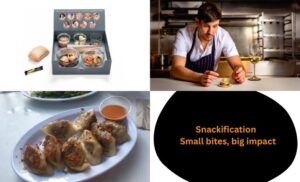
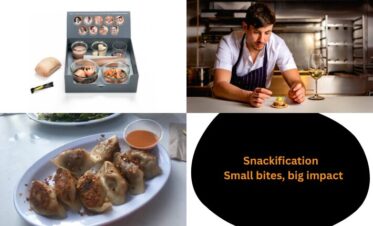
Snackification – small bites, big impact